
It is the question parents ask most and the one that gets answered least clearly: are there scouts at football camps? Most of the industry answers it with a phrase like “high visibility” that means nothing at all. At Ertheo we answer it the way you answer it on the phone to a parent, which is where you cannot dodge.
The short answer is that it depends on the camp, and that the difference between one camp and another is enormous. There are camps where nobody is assessing anyone, and nobody should be — and there is one built precisely so that you are assessed. Let’s take them in order.
Table of Contents
Scouts at football camps in summer: there are none
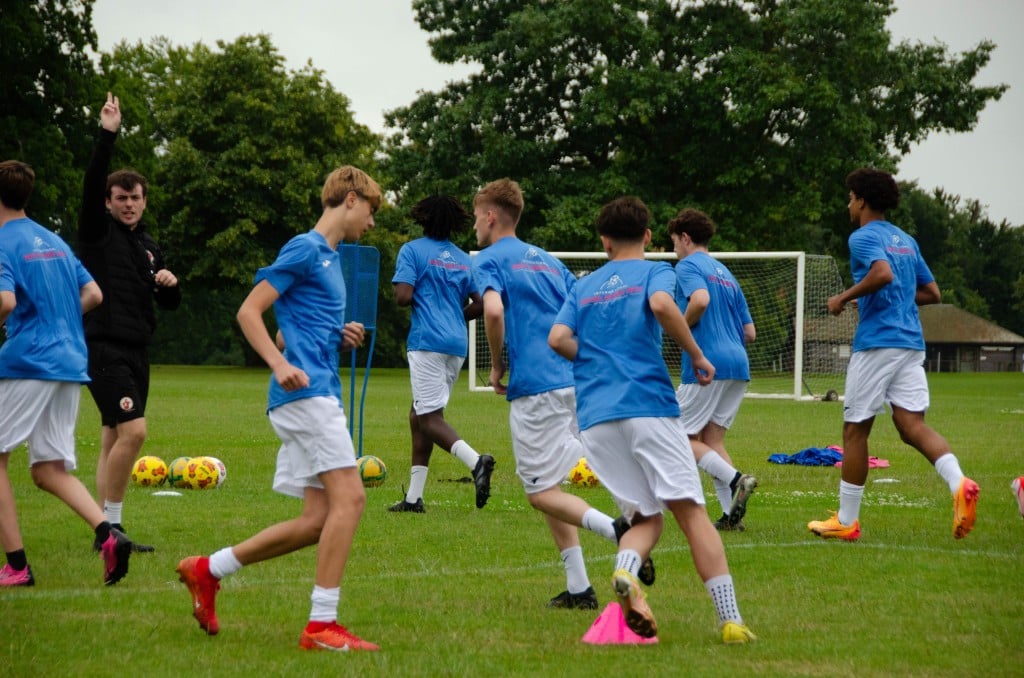
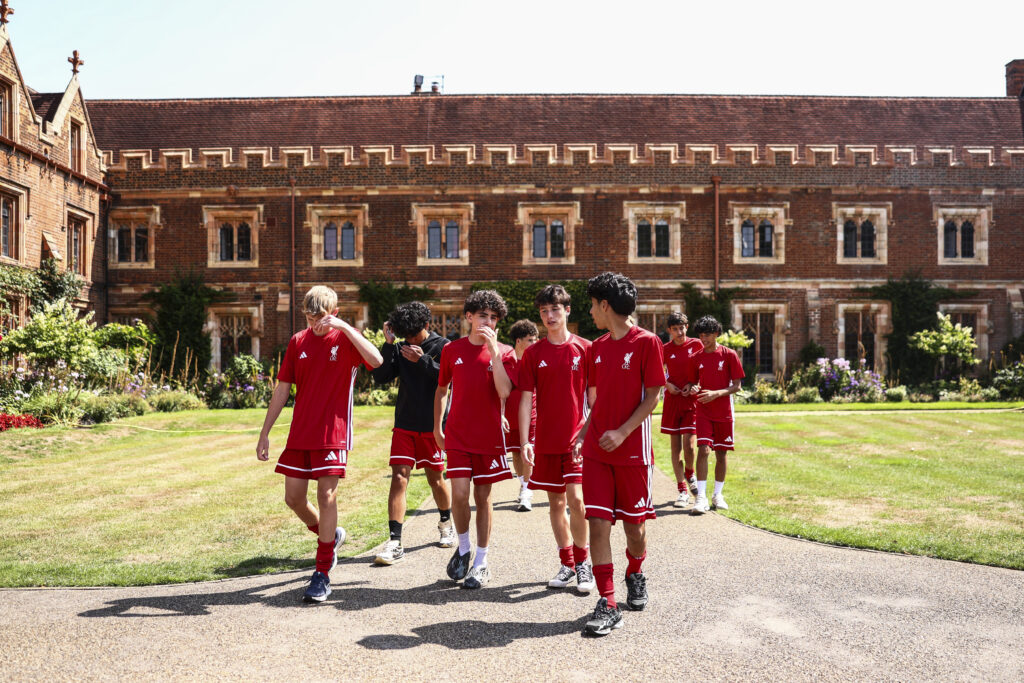
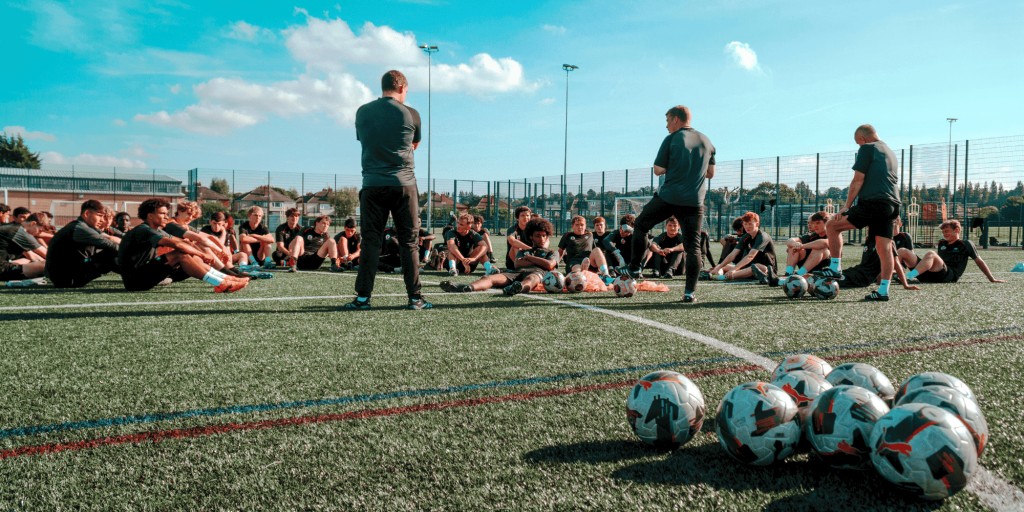
At the camps that carry a big club’s name — Arsenal, Chelsea, Manchester City, Tottenham, West Ham, Atlético Madrid — there is nobody from the football department watching in order to sign anyone. There are coaches, often the club’s own and holding UEFA A, B or Pro licences, and there is a serious development programme. But a coach correcting the angle of your first touch is not a recruiter filing a report to a club.
We say it because the confusion is not harmless: a family who pays for a camp expecting a scout to appear comes home disappointed by a programme that was good. The camp did not fail. The expectation was set wrong, and usually it was set by whoever sold it.
What a camp does give you, and it is not nothing
A good camp does not sell exposure: it sells training and a measurement. And the measurement is the part almost nobody makes use of.
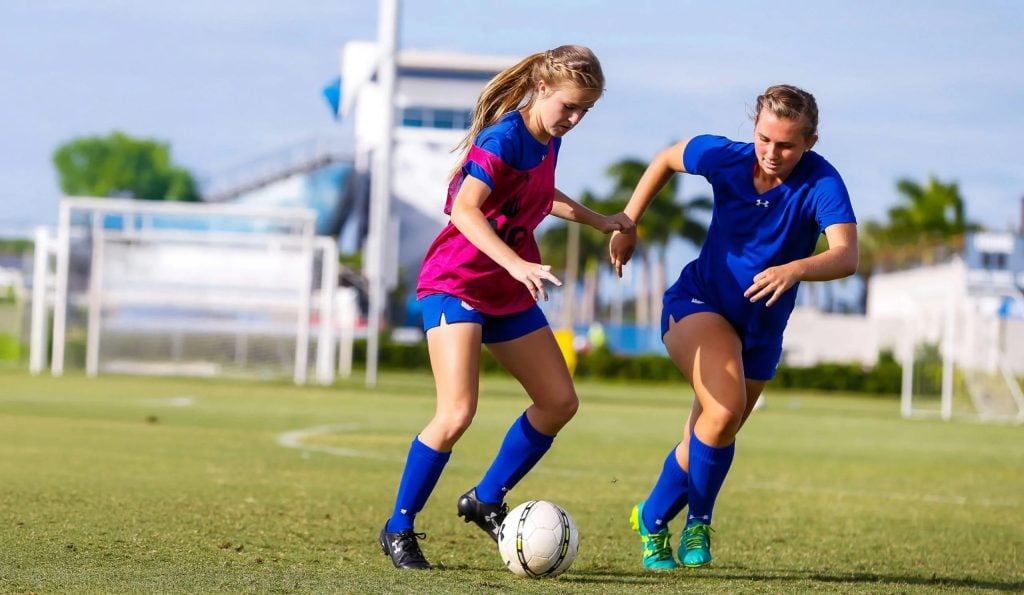
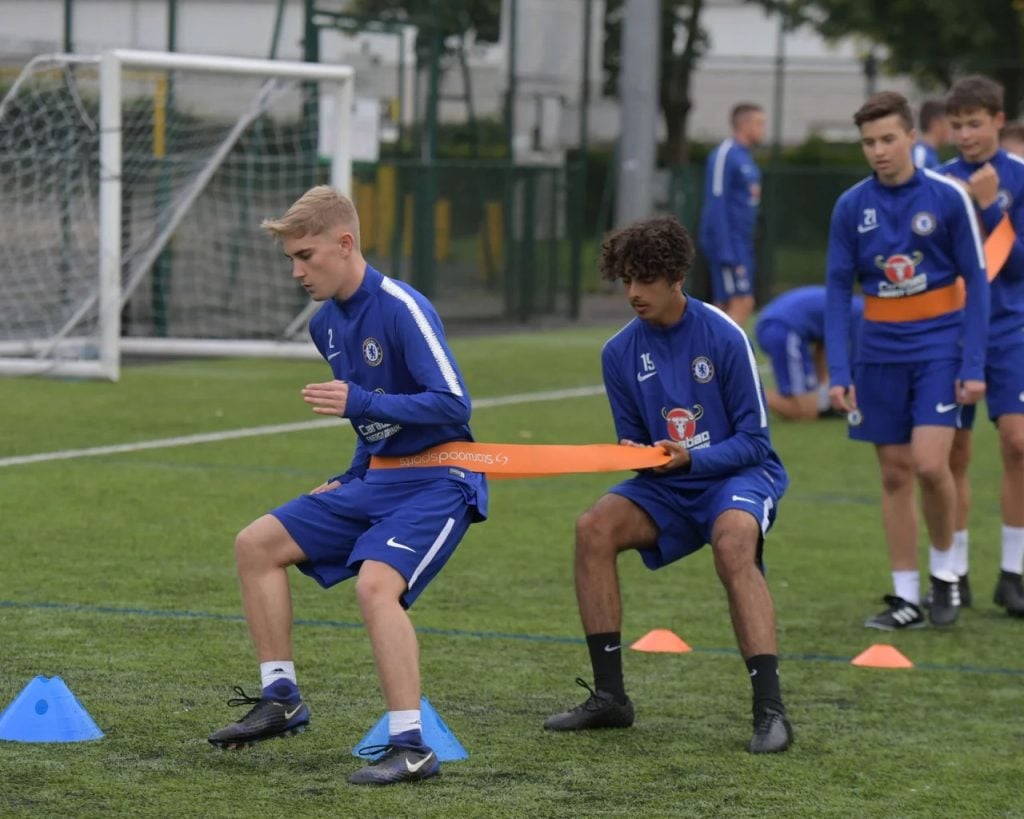
- A training load that does not exist at home. Several sessions a day for one or more consecutive weeks. A player who trains three evenings a week has never lived at that rhythm.
- Coaches from outside his own world. Somebody who does not know the boy, does not know his father, and does not have to keep anyone at the home club happy.
- An individual written report, on the programmes that include one. Technique, physique, reading of the game and attitude.
- Data, on the high-performance ones. GPS and VEO recordings: for the first time the boy sees what he does, instead of being told about it.
That is what to ask for and compare when choosing. A camp with an individual report is worth considerably more than one without, and the price difference rarely reflects it.
The exception: a camp built so that you are assessed
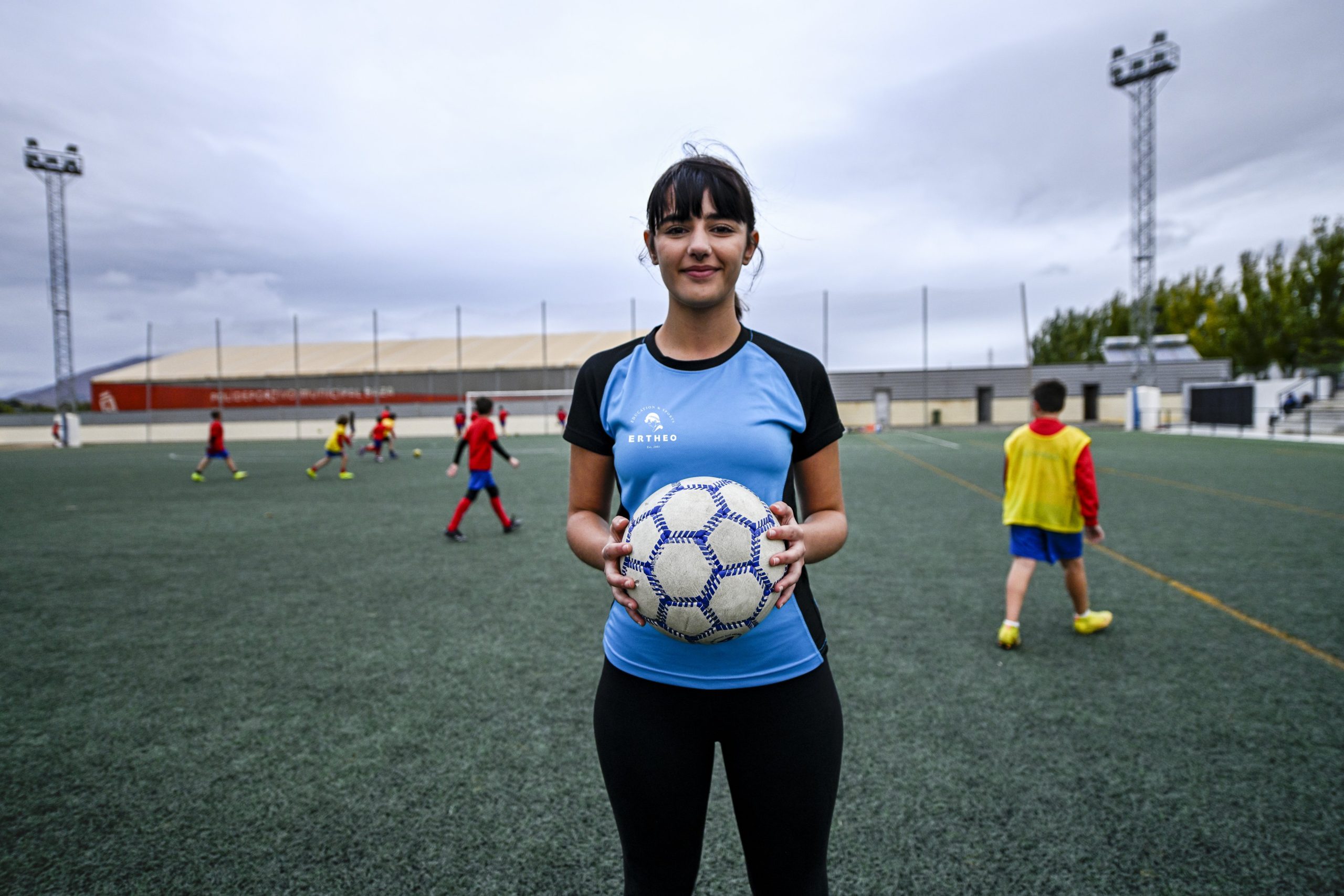
There is one case that breaks the rule, and it is worth knowing because it is the bridge between a camp and a trial. At the Barcelona Pro-Clubs Experience you do not train with summer camp monitors: you train with the people who run recruitment and methodology at professional clubs competing in Spanish football — Girona FC, CD Leganés, CD Castellón, Albacete Balompié, SD Huesca and FC Andorra.
That changes the nature of the week. Training each week under a different coaching staff, the player is assessed by several institutions at once, and not only on match day. And the programme culminates in a Tryout in the third week in front of professional scouts from LaLiga and LaLiga2.
Which is why, for anyone who wants both things — to prepare and to be seen — it is the most sensible combination: you arrive at the Tryout with two weeks of work behind you, adapted to the tempo of Spanish football and already known to the staff who will be assessing you.
Three different things we all call “being seen”
Most of the misunderstanding clears up once you separate three products that look alike in a brochure and are nothing alike in what they solve.
| Camp | Academies Clinic | Trial at a professional club | |
|---|---|---|---|
| Who is watching | The programme’s coaches | High-performance academies, plus scouts at two friendly matches if you take the service | Scouts from professional clubs |
| What they are looking for | Nothing: they are teaching | Students for their full-year programme | Players for their academy |
| What can come of it | Improvement and an individual report | A place at an academy, sometimes at a reduced fee, and a scout’s report if you take the service | A free trial week at the club’s training ground, earned by standing out, and from there a contract |
| What level it is for | Beginner to elite | High or elite | Advanced or elite |
All three are legitimate. What is not legitimate is selling the first while describing the third. The High Performance International Clinic is the second: several academies take turns running the training and each one assesses. And if it is the third you want, the dates are on the football trials with professional clubs page, with the venues and the name of every club; what one is like from the inside, day by day, we cover in the guide to what a trial at a professional club is really like.
The Clinic has a middle door, and it is worth measuring properly
Between the camp and the trial there is a step almost nobody explains. At the Oakham Clinic, scouts are invited to watch two friendly matches, one for each two-week programme. Families who take that service — it is an extra, with its own fee — then receive a full scout’s report on their son.
And here is the exact measure of it, which is the part that almost never gets said: the scout watches one match, not one week. The report rates the player physically, tactically, technically and psychologically, lists his strengths and the areas he needs to work on, and places both the level he plays at today and the level he could reach. It is a genuine professional evaluation, written by someone who does this for a living, and it is made over ninety minutes.
It is a good deal more than a camp and it is less than a trial, which is exactly why it sits in between. If what you want is a professional opinion in writing about your son, this gives you one. If what you want is several clubs weighing him up across several days in order to decide about him, that is a trial.
Why a scout does not turn up at Sunday’s match
The mechanics are worth understanding, because they explain why an ordinary camp could not bring scouts even if it wanted to. A scout is not looking for good players: he is looking for the player his club needs this season. A profile, a position, a birth year. He goes where he is sent, with a list, and writes a report somebody is going to read.
That is why he does not go to a summer camp: there you have boys of mixed levels, with no registrations, no assigned positions and no competitive fixtures. It is not that the camp is bad. It is that it is not an environment where anyone can be assessed for signing. A trial is, because it is built the other way round: a closed list, several sessions and assessment matches.
Clubs’ own recruitment days: what they are and what they are not
This is worth saying even though it does not suit us commercially. Clubs run their own recruitment days for their academies, and they are usually free or close to it. If your son lives near a club and fits the age they are calling up, it is a real route and it costs nothing. You find it on the club’s own website, not through an agency.
What you need to know is what it is: a lot of people, a single session, and a few pairs of eyes for all of them. It works for the player who already stands out at first glance. What Ertheo sells is the opposite, and that is why it is paid for: several consecutive days, staff assessing at every session, and a written report at the end.
And the advice we give on the phone to anyone whose budget is tight: start with the recruitment day at your own city’s club. If nothing comes of it, you have lost a Saturday. An international programme makes sense once the player is already beyond what his own surroundings can measure.
One warning about any programme that lists club names, ours included: each club’s attendance depends on its own fixture list and is confirmed with the family before the session. Anyone who promises you a specific club on a specific date without that condition is promising you something they do not control.

How to tell whether he needs a camp or a trial
The question is not how old he is, it is where he has got to. The age spans are a guide and never a sieve: a player near the edge of one is a conversation, not a rejection.
- If he is still building his technical foundation — good control but he loses his position, or the tempo beats him when he moves up an age group — he needs a high-performance camp. At a trial he is assessed exactly as he arrives; it is not where a player improves, it is where he is measured, and an assessment that comes too early discourages more than it teaches.
- If he already competes at regional or national level and holds the tempo against players a year older, a trial makes sense: there is something to show.
- If the question is the whole of next year, rather than a few days, it is a different question and we answer it in the guide to football school or academy.
There is one clue worth more than any test: what a coach who does not love him says about him. Praise from people who are fond of him is not information.
Six questions before paying for anything
They work for any programme and any provider, Ertheo included. If any of them has no concrete answer, you have learned something.
- Is this a camp or a trial? Meaning: is somebody coming to assess, or only to coach? Both answers are good ones. The bad answer is not knowing which of the two they are selling you.
- Who runs the sessions and where do they come from? Licence and background. “Qualified coaches” is not an answer; “UEFA A, and the recruitment leads from club X” is.
- Is there an individual written report at the end? Yes or no. It is the difference between coming home with an opinion and coming home with a document.
- What exactly happens if he stands out? Ask them to describe the next step. If there is no next step, it is a camp, and there is nothing wrong with that.
- What level is the group pitched at? Beginner, intermediate, advanced or elite. A player far above or far below his group loses the week.
- Who is my contact during the programme, and in what language do they reply? Especially if the boy is travelling alone and it is his first time.
In short
Scouts do not go to an ordinary summer camp, and that is fine: it is not what a camp does. What it does is train hard, for days on end, and — on the good ones — hand you back in writing what level your son is at.
But “camp” is not one single thing. There is one whose coaches are the recruitment and methodology leads of professional clubs, and whose third week is a Tryout in front of scouts: there you genuinely are being watched. And if what you want outright is to be seen by somebody with the power to sign you, that is a trial, it has a different name, and it brings scouts from clubs that can be named one by one: they are on the football trials page.
And if what has to be settled first is which of the three he needs now, that conversation is arranged from there too. It is a good moment for it: summer camps are booked months ahead, so autumn is when it gets decided without any rush.