
A father writes asking about a football school in Spain for his fifteen-year-old. By the second email it is clear what he actually wants: the boy to move to Spain for a full academic year, train every day and keep studying. That is not a football school. That is an academy, and they are two different things.
The two words get used as synonyms and they are not. The confusion matters, because it leads some families to ask for a quote on something they do not need, and others to rule out on price a programme they never properly understood. This guide explains what each one is, what age it suits and how to tell which your son needs right now. If you already know and you want to see the options, they are on the football academy programmes in Spain; and if something shorter is the fit, on the soccer camps and programmes.
Table of Contents
What a football school is
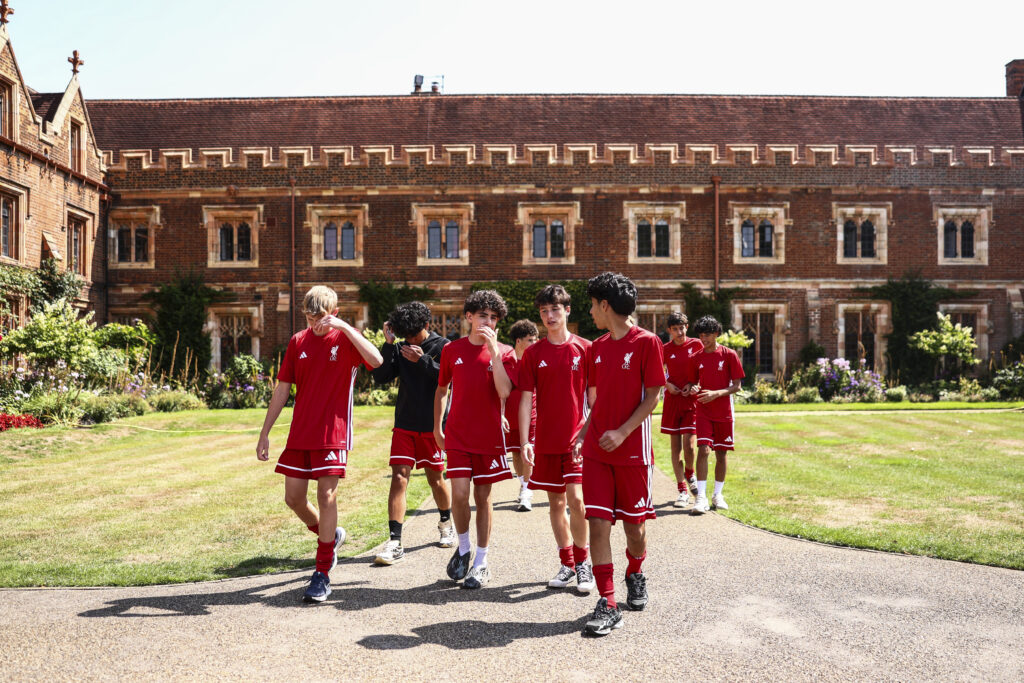
A football school is where your son trains and competes without his life changing. He goes two, three or four afternoons a week, plays his league at the weekend, sleeps at home and goes to his usual school.
It is how the overwhelming majority of children in the world play football, and for the overwhelming majority it is the right answer. A good school can have excellent coaches and a serious method. What it does not have — because it is not its job — is any control over the rest of the day: what he eats, how much he sleeps, how much he studies and how much he rests all still depend on home.
What a high-performance academy is
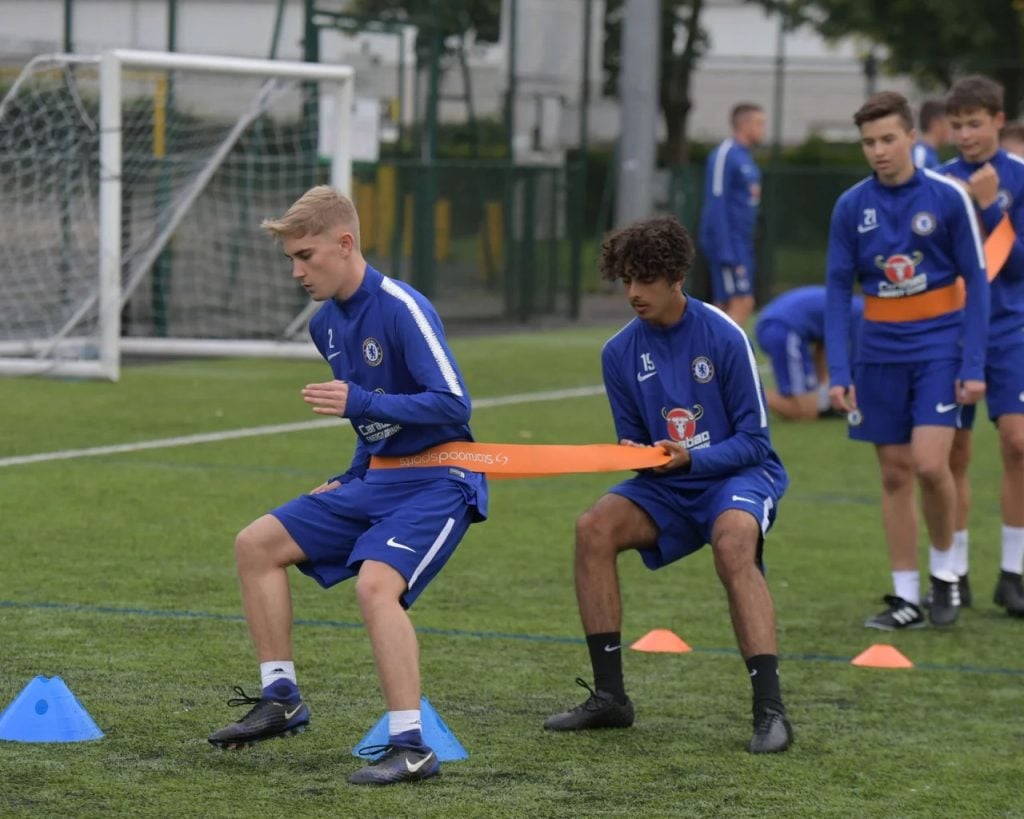
An academy is a programme lasting between 3 and 11 months in which the player relocates, lives on site or in an associated residence, trains every day with professional coaches and continues his studies inside the same programme. It includes full board and round-the-clock supervision.
That last sentence is the one people skim, and it is the important one. In an academy, school is not something sorted out separately: it is part of the programme, with teaching hours arranged around training. In the Spanish academies that can mean following the Spanish, American or British system, preparing for the US university entrance exam, or taking vocational or university-level studies, depending on the centre and the age.
The jump from a school to an academy is not a jump in football level. It is a jump in how he lives. Your son stops living at home.
The table that settles it
| Football school | High-performance academy | |
|---|---|---|
| How long | The season, with your club | 3 to 11 months |
| Where he sleeps | At home | At the academy or residence |
| School | His own, separately | Inside the programme |
| How much he trains | 2-4 sessions a week | Daily, with professional coaches |
| Meals | At home | Full board |
| Supervision | During training | 24 hours |
| Usual age | From 5-6 years old | From 12, depending on the centre |
| Paperwork | None | Visa, enrolment, insurance, guardianship |
| The cost | A monthly fee | Another order of magnitude |
What age each one suits
This is the part that settles the decision most often. Before the numbers, a warning that applies to all of them: these are general ranges, not an entrance exam. Every academy has its own, and every one of them looks at the player who falls just outside before saying no.
- Up to 11-12: a football school during the season, and a summer camp if you want an intensive experience without moving your son away from home for more than a few weeks. In Spain the camps take players from 8; outside Spain they usually do not start until 11 or 12. And there is one exception worth knowing: the Barcelona academy takes players from 8 on the full-year programme, but without the residence — at that age the player lives in the city with his family.
- From 12 onwards: the full-year academies with a residence start to open, and each centre sets its own range. The Barcelona one takes players from 12 up to 21; the Valencia one works with boys from 15 to 22. These are general ranges, not entry requirements, and they shift from one academy to the next.
- From 18: academies still apply, and the university route comes into play as well, particularly towards the United States.
And the most important thing in this whole section: falling a year short is not a no. A fifteen-year-old for a programme that works from sixteen is a conversation, not a rejection: his level, his maturity and the places available all count. If your son is near the edge, ask about him rather than deciding it with a table. And if there genuinely is time to spare, there is a route before it — school, summer camp and short stays at the academy itself — which is where almost everyone who ends up enrolling starts.
What nobody tells you: the paperwork
Academy websites talk about coaches, facilities and minutes of competitive football. Almost none of them talk about what actually rules families out, and nearly always late:
- Visa. For a player from outside the European Union, a stay of more than 90 days requires one in most programmes. It is not a last-week formality.
- School enrolment. The student has to be registered in whichever education system applies, and that has its own deadlines, which are not football’s.
- Medical insurance. Compulsory, and separate from any travel insurance you already hold.
- Legal guardianship. If your son is a minor and will live abroad for a year, somebody has to hold that responsibility in writing.
None of these four is insurmountable. All four together explain why an academy is not booked in a week, and why any serious entry into a full-year programme goes through a conversation rather than a shopping basket.
The step worth taking first
If after all this your conclusion is that an academy is the fit, the recommendation is not to sign up for a full year. It is to go for one or two weeks first: a summer campus at that same academy, an intensive course or a trial.
There are two reasons, and almost nobody explains the second.
- So you can see it. A year away from home is a big decision, and a fortnight on site answers questions no website can: whether the environment suits your son, whether the level is his, whether he can take the routine.
- So they can see him. Scholarships for long programmes do exist, but they are only offered to players the academy has seen in person. No academy grants a scholarship on the strength of a video. If financial help is part of your thinking, a short stay is not a cost beforehand: it is the only door there is.
And the other half needs saying: a short stay guarantees no scholarship. What it guarantees is that the possibility exists at all, which without it is zero.
How to tell which one he needs today
No quiz, no scoring. Three questions, and the first one you can answer clearly already decides it.
- Does your son want to live away from home for a whole school year? The answer has to be his, not yours: he is the one who will live it. If he is not sure, the academy is not the step yet: the step is to stay at his football school and try a summer camp, which is exactly how you find out without committing a year.
- How old is he? From 12 a full-year academy in Spain is already a real option; below that, what fits is a football school and a summer camp — which in Spain start at 8. If he is right on the edge of a centre’s range, that is a question for us and not for the table.
- Have you ever been to the place? If not, the next step is a short stay, whatever the answers to the first two.
In short
A football school improves the player without changing his life. An academy changes his life in order to improve the player. Both are good decisions; what is not a good decision is choosing one believing it is the other.
If the academy is the fit, the options in Spain — with their ages, durations and study plans — are on the football academies in Spain page. And if what comes first is trying before deciding, that is arranged from there too.