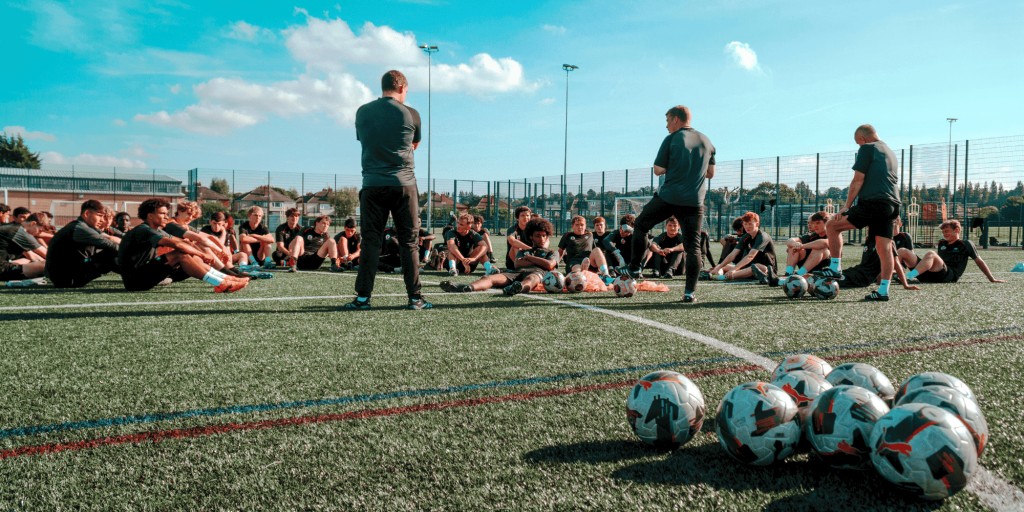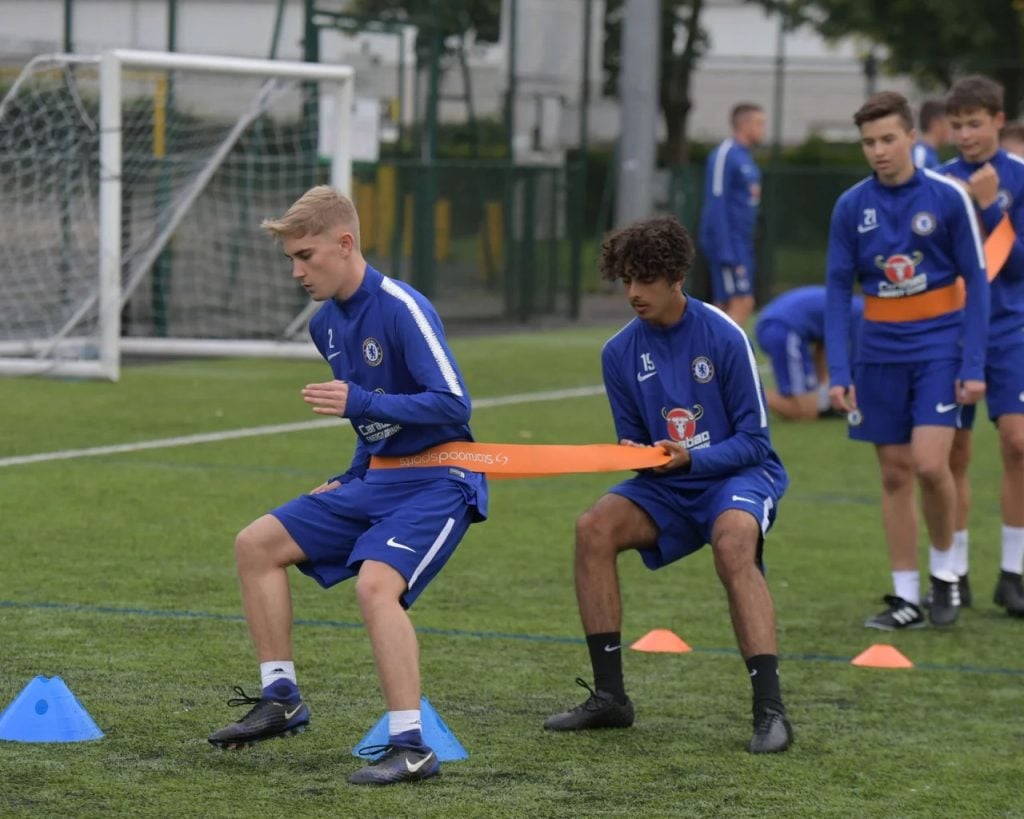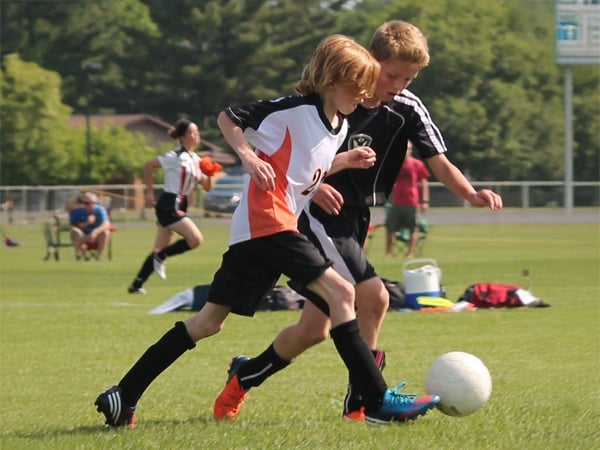

A sixteen-year-old plays well. His coach can see it, his team-mates’ parents can see it, and he knows it himself. And he can still go three seasons without anyone from professional football watching him play a single minute, because a scout is not going to turn up at Sunday’s match. That is not bad luck: nobody has told them to go.
That is where football trials come from. The ones Ertheo organises are several consecutive days built for one purpose: to put the player in front of scouts from professional clubs, several times over, and to send him home with a written report of what they saw. This guide explains what a football trial at a professional club is actually like: what happens each day, who exactly is watching, and what follows if you stand out. If what you want is the dates and the venues, they are on the page for Ertheo’s football trials.
Table of Contents
What a trial at a professional club is — and what it is not
This is the most common confusion and the one that causes the most disappointment. A high-performance camp is built around training: the player improves and competes, and if somebody happens to come and watch one day, that is a bonus.
A trial is built the other way round. Everything that happens over those days exists so that somebody can make a decision about that player. The scouts are not passing through: they have been invited, they have the players on a list, and they are going to write about them.
Who is watching, by name and by division
This is what separates a real trial from a promise. Sixteen professional clubs from Spain, Andorra, Portugal and England are taking part in the December 2026 and January 2027 sessions, across three venues.
| Venue | Dates | Clubs whose scouts attend |
|---|---|---|
| Barcelona | 17-21 December 2026 | Girona FC, CD Leganés, FC Andorra and CD Castellón (Segunda División) and SD Huesca (Primera Federación) |
| Madrid | 13-19 December 2026 | CD Leganés (Segunda División), SD Huesca and Marbella FC (Primera Federación), UE Cornellà and CD Estepona (Segunda Federación), CD Toledo and CP Mijas-Las Lagunas (Tercera Federación), CF Atlètic Quart de les Valls (Lliga Comunitat) and Boavista FC (Portuguese fifth tier) |
| Northampton (England) | 15-19 January 2027 | Tottenham Hotspur (Premier League), Derby County and Bolton Wanderers (Championship) and Northampton Town FC (League One) |
And the small print, because you will want to know it: each club’s attendance depends on its own fixture list and is confirmed with the family before the session begins. What does not change is the format, or the number of sessions in which the player is watched.
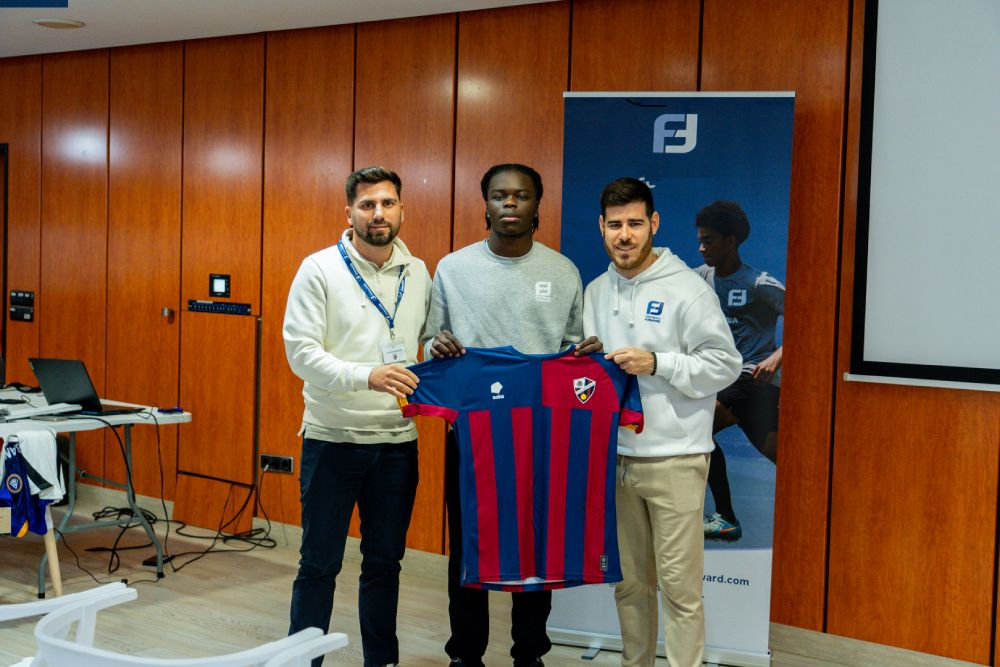
What a day looks like, hour by hour
This is a day at the Spanish sessions: five and a half hours on the pitch, with full-board accommodation and all transfers included. The day repeats with little variation:
| Time | What happens |
|---|---|
| 08:30 | Wake-up. |
| 09:00 | Breakfast. |
| 10:00 – 12:30 | Training session. Technical and tactical work, with the scouts present. |
| 13:00 | Lunch. |
| 14:00 | Rest and free time. |
| 15:30 | Transfer to the facilities. |
| 16:00 – 18:30 | Assessment match in front of the scouts. |
| 20:00 | Dinner. |
| 21:00 | Technical talk and rest. |
There is one detail in that grid that reassures any parent: the scouts are at the morning sessions and at the afternoon matches, every day. It does not all come down to one afternoon. A bad game on Tuesday does not erase what they saw on Monday, and a boy who takes time to settle has more days in which to do it. That is the difference between an assessment and an audition.
The three rungs: what happens if you stand out
Almost nobody explains this part, and it is the part that gives everything else its point. The route has three rungs.
- The trial. The family pays Ertheo for the session so that their son is seen by the scouts and the participating clubs. That is what is being bought: the access, not the outcome.
- The week at the club. The standout players from each session earn a week’s trial, at no cost, at the training ground of the club that selects them, training with the squad and in front of its coaching staff. It cannot be bought or booked: it is earned by standing out.
- The contract. If he stands out there too, a professional contract becomes possible.
The second rung is what separates a trial from an expensive tournament: there is a real door into the club, not just a report in PDF. And it is worth reading what it does not say, too. “The standout players” is not “your son”. Nobody guarantees that rung, and anyone who does is selling something else.
Three who did make it
The question left hanging is whether the third rung really happens. These three came out of the Barcelona Football Tryout, the same Barcelona session that appears in the table above:
- Papa Samsou Niang, from Senegal, signed for the Deportivo de La Coruña youth academy after winning the fourteenth edition.
- Derron Elijah, from Trinidad and Tobago, signed for FC Andorra — one of the clubs attending in December — after standing out at another edition.
- Matías Piteo, from Argentina, signed for Atalanta.
They are three names, not a statistic: proof that the door exists, not that it opens for everyone who walks in. But their countries say something else as well. None of the three would have been seen by those clubs playing at home, and that is exactly the distance a trial closes.
There are two kinds of scout, and an agency that is not one
When somebody says “there will be scouts there”, they are not all the same thing, and the difference matters.
- Scouts for a single club. They work exclusively for that club and are looking for what it needs this season: a profile, a position, a birth year.
- Scouts who work for several clubs. These are the ones attending the England session. Working for several does not mean they are not scouting for the clubs named: they scout for them, and they also take the report to more than one table. A single convinced scout can open two or three doors at once.
And there is a third figure who is not a scout at all and is worth not confusing. A player representation agency takes part in the Barcelona session — the same agency that represents players such as Fede Valverde and Alejandro Grimaldo. An agency does not sign anyone: it manages the player’s career. It is a separate and complementary route: if an agency like that decides to take a player on, his chances of eventually signing rise considerably, because from then on somebody’s job is to put him in front of clubs.
If you want to understand better how a scout actually works — what they look for, how they build their reports and why they take their time deciding — we cover it in our guide to the role of the scout in modern football.
What he comes home with, whatever happens
This is what makes the trial worth it even when no call comes. At the end, every player receives an individual report written by the coaching staff: technique, physical condition, reading of the game, attitude and a recommended path.
It is not a certificate of attendance. It is the first time somebody who makes a living assessing footballers writes down, without having to keep anyone happy, what level the player is at and what he is missing. For a sixteen-year-old who has spent half his life hearing opinions from people who love him, that piece of paper is worth the trip on its own.
The England session has one further feature: it is held at the University of Northampton, and the players get access to its high-performance laboratory, where they undergo an individual physical assessment. Depending on pitch availability, part of the training may take place in Stamford.
Which venue suits which player
- Barcelona and Madrid point towards Spanish football: from Segunda División down to Tercera Federación, plus a Portuguese club in Madrid. It is the natural route for a player who plays in Spain, or who wants to.
- Northampton is a different proposition and works differently. There, Ertheo works with a scouting agency with more than a hundred professionals across the United Kingdom, and the clubs on the list are a selection of those they represent, from different divisions. The format changes too: three days of double training sessions and one match day, four days of football. And the criteria are British — intensity, tempo and direct play — so it becomes clear fairly quickly whether the player fits that style or not.
And there is a fourth option that is not part of these winter sessions, but that is worth knowing about when the obstacle is not a footballing one: Ertheo also runs trials in Tangier, designed for players with the level but for whom getting a Schengen visa is the real barrier. Taking the trial to Morocco removes it outright.
What level is needed, said plainly
The age span varies by venue: the Spanish sessions are open from age 12 and the England one from age 16, both up to 23, and to players at intermediate, advanced or elite level. The span is a guide and not an entrance exam: a player close to the edge of it is a conversation, not a rejection.
But there is something worth saying even though it does not help to sell: if the player is still building his technical foundation, he will get far more out of a high-performance camp than out of a trial. At a trial he is assessed exactly as he arrives; it is not the place where a player improves, it is the place where he is measured. And an assessment that comes too early discourages more than it teaches. If that is the question — development or assessment — we answer it in full in our guide to which programme your son needs right now.
The other door: scholarships
Not everyone who stands out ends up at a club’s training ground. There is another way out that most families do not know about: high-performance academies award full or partial scholarships to players who have stood out at a trial, for a programme of daily training combined with schooling.
They are decided on performance, assessed case by case, and none of them is automatic. But they fit with something we have already covered in explaining what a day at an academy looks like: an academy only offers a scholarship to a player it has seen in person. Nobody awards one on the strength of a video. A few days in front of their coaches is often the only way that possibility comes to exist at all.
In short
A football trial does not promise a contract. What it solves is an earlier and more basic problem: that nobody with the power to decide has seen your son play. A few days, sixteen clubs across the three venues, scouts at every session, and a written report at the end, stand out or not.
The December and January dates, the venues and the clubs at each session are on the page for football trials with professional clubs. And if what has to be decided first is whether the player is ready for a trial or still needs to develop, that conversation is arranged from there too.