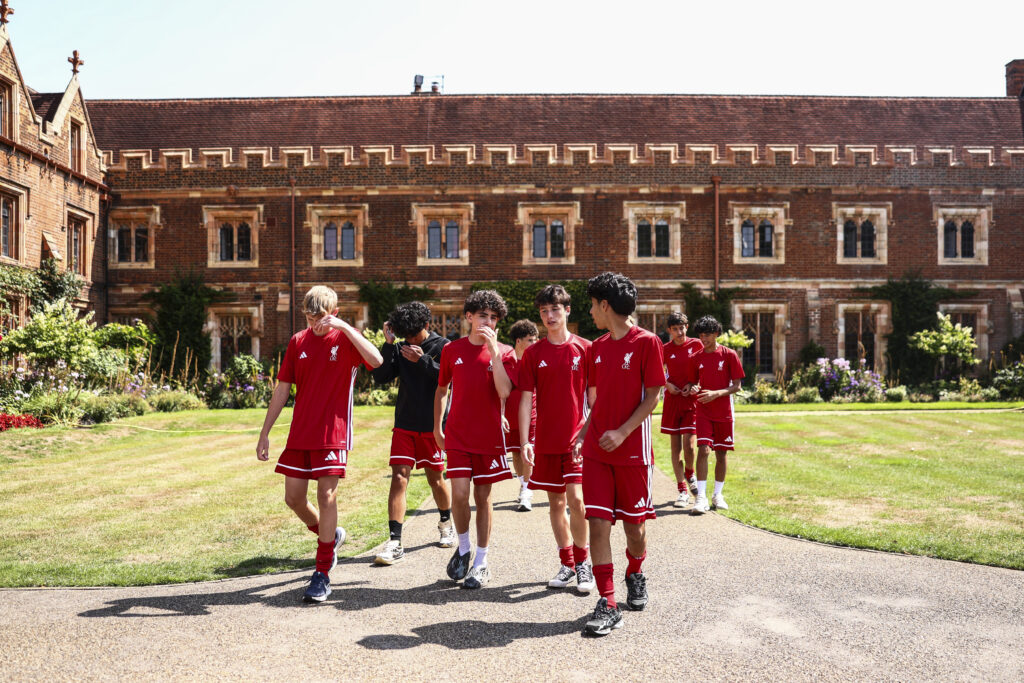

There is one question that arrives before the price, before the dates and before the country: is my son ready for a high-performance football camp? It is the first question in almost every call we take, and it almost always brings the same fear with it: that the boy will be out of his depth, that he will spend a week as the weakest player on the pitch and come home with less confidence than he left with.
That fear is reasonable, and it is looking the wrong way. What we see from inside the programmes we run is the opposite: the mismatch that really spoils a week is not the player who falls short, it is the good player put into a soft group. He enjoys himself, learns nothing he did not already know, and comes back without a single answer about his level.
This guide is here to tell you whether your son is ready for a high-performance football camp, and to place him in about five minutes. First, what actually separates a high-performance football camp from a club camp, which is not the training hours. Then a five-question self-assessment that ends in a concrete recommendation rather than a reflection. And at the end, why the most expensive camp is not the one with the highest level. Ertheo runs both kinds, and that is precisely what allows us to tell you when the more demanding one is not the one for you.
Table of Contents
The mismatch that wastes the most money is not the one you fear
A level mismatch can happen in two directions, and almost all of the public conversation only talks about one of them.
- Upwards: a boy who plays for the fun of it, placed in an advanced group. He spends the week chasing the ball. This is the fear the parent arrives with.
- Downwards: a boy who already competes seriously, placed in a group that accepts beginners. He stands out without trying, has a good time, and comes home exactly as informed about his level as he was when he left.
The second is by far the one we have seen most often, and the one that sits worst when the family works it out halfway through the week. There is a simple explanation for that: a level that is too high shows on the first day, which is exactly when the coaches adjust the groups; a level that is too low never shows at all, because the boy is happy. Nobody complains about a pleasant week. It simply did not do the job it was paid to do.
That is why an honest self-assessment has to measure both directions. The useful question is not “will he cope?”, it is “who is he going to train with?”.
And if he ends up in the wrong group, can it be changed?
That is the question that comes straight afterwards, and the honest answer has two parts. The first takes away almost all of the fear: groups are not confirmed in advance, at any camp. They are formed after the first day. The boys are grouped by age to begin with and then, once the coaches have seen them play, the groups are adjusted by level. Nobody is stuck on Monday in a group chosen on paper.
The second part is who decides, and it is worth saying just as plainly: the level of each group is set by the coaches, not by Ertheo. It works exactly as it does at your son’s club. If you tell us something you believe the coaches ought to know before they see him play, we pass it on; the final decision is theirs. And that is precisely what makes a level group mean something: if the person paying chose it, it would stop being a level group.

What makes a high-performance camp different
A high-performance camp is not a summer camp with the intensity turned up. It is a different product, with a different purpose. The day is built around four blocks: training, physical conditioning, tactical and video analysis, and competitive matches. It usually also includes modules on sports psychology, nutrition and injury prevention, because those are part of how a player who competes works.
Three features define it above everything else:
- It selects by level. It asks for an intermediate-high level and goes up from there to elite. It does not accept a player who is just starting out, nor one who cannot yet hold a competitive tempo, and that filter is exactly what makes the group worth something.
- It is run by UEFA-licensed coaches, several of them with experience at professional clubs; on the England programme, with experience in the Premier League and the Championship. The session looks like a professional academy session: precision, speed of play and decision-making under pressure.
- It measures, and it leaves a written record. GPS and VEO video recordings are used, and the player goes home with an individual report on technique, physical condition, reading of the game and attitude. For the first time the boy sees what he does, instead of being told about it.
What he takes home, therefore, is not an anecdote: it is an honest reading of what his real level is. How he plays against boys he has never seen before, when nobody on the pitch already knows in advance that he is good. His own league cannot give him that information, because in his league they already know him.
Ertheo runs the high-performance football camp in England, based in Oakham, along with high performance in Barcelona and high performance in Valencia.
What a club camp is, said without condescension
This is worth saying early, because the rest of the article reads badly without it: the club camp is not the poor product of the two. It is a different product, very well made, for a different boy.
It is organised under the name of a professional club, often at the club’s own facilities, and it is designed for the boy who is as much a supporter as he is a player. The training is adapted by level and accepts absolute beginners; the rest of the day is built like a summer camp, because that is what it is. The groups are mixed, several of them offer language classes as an option, and because of the number of participants they can split the boys by age and by level, which is what allows the training to pay off.
The coaches are often from the club itself and hold UEFA A, B or Pro licences. The technical development programme is serious. What there is not is anybody from the sporting department watching in order to sign players: a family who pays for a club camp expecting a scout to appear comes away disappointed by a programme that was good. The camp did not fail; the expectation was in the wrong place. We set it out in full in the guide to scouts at football camps.
Ertheo’s catalogue includes, among others, Arsenal, Chelsea, Manchester City, Tottenham, West Ham, Aston Villa, Atlético de Madrid, the FCB Escola, AC Milan and Paris Saint-Germain. What a boy brings back from one of those is a fortnight he will talk about all year, and that has a perfectly legitimate value.
What really separates them: three things, and the hours are not one of them
A great deal of camp comparison is played out on weekly training hours, and it is misleading ground: the load of a high-level club camp and the load of a high-performance camp are closer than you would expect. If you choose on that number, you are choosing on the figure that tells the two apart least.
What does separate the two products is three things:
| Club camp | High performance | |
|---|---|---|
| Who he trains with | Groups by age and level, within a range that starts at beginner | A selected group: from intermediate-high up to elite, and nobody below that |
| Who runs the session | Club coaches with a UEFA A, B or Pro licence, working to a technical development plan | UEFA-licensed coaches with experience at professional clubs, working to an academy plan |
| What there is at the end | An experience, and whatever the boy tells you about it | A written measurement: individual report, video and GPS data |
Of the three, the first is the one that decides the week. The level of the group is the programme. Two camps with the same timetable and the same grass produce different weeks depending on who the boy trains with, and that is the reason level is the first question in almost every call.
Self-assessment: is he ready for a high-performance camp?
Answer all five looking at the column that best describes your son today, not the one you would like. The question is not how old he is: it is where he has got to.
| The question | Column A | Column B |
|---|---|---|
| 1. Where does he compete? | He plays for his school, at a football school or in his town’s local league | He competes at county, regional or national youth level with his club |
| 2. What happens when he moves up an age group? | He struggles with the tempo; his touch is fine but he loses his position | He holds the tempo of a team a year older without disappearing from the game |
| 3. What place does he hold in his team? | One of the squad, and he enjoys being that | He is one of the players who decide matches, and his coach counts on him for it |
| 4. Why does he want to go? | For the badge, for the summer, for the group | To find out how far he can go, and the badge means nothing to him |
| 5. What do you want him to bring back? | A summer he will talk about all year, and friends from other countries | A written report on what he has to work on |
How to read the result
- Four or five answers in column A: club camp, without hesitating. A high-performance programme is not going to make him a better player this summer; it is going to teach him that there are better boys, and that lesson will reach him on its own soon enough.
- Four or five in column B: high performance. And here is the important warning in this article: if you send him to a club camp “to toughen him up a bit”, he will come back without having found out anything, which is exactly what you did not want.
- Two or three in each column: this is the most frequent case and the most interesting one. It usually means a player who has the level but not yet the head for it, or the other way round. Look only at questions 1 and 2 — the ones that measure the football and not the motivation — and decide on those.
Two clues worth more than the test
The first: what a coach who is not fond of him says about him. Praise from someone who thinks well of him is not information. The opposing coach, the coach of the team that did not sign him, the coordinator who left him out of a squad: that is where the useful reading is.
The second: if you are torn between two, go for the shorter one. One week tells you almost everything a fortnight would tell you, and it costs one week. Getting the type of camp wrong for seven days is a short mistake; for fifteen, it is the same mistake for longer.
And one thing that is not a filter: age bands are guidance, not an entry requirement. A boy who falls just outside one is a conversation, not a no. The exact ages and level for each programme are confirmed when you book.
What to do with the result, case by case
- He is starting out, or he plays because he loves it. This is the typical profile from eight to twelve, and the club camp is the right product: we say so even though it is the less ambitious of the two. Nothing is being decided in sporting terms at that age, and what does happen — training away from home, living alongside boys from many countries, surviving a week without his parents — is worth a great deal more than a report he would not yet know how to read. The options are on the football camps page.
- He has a solid base and competes for his club. The twelve-to-sixteen stretch is where the test really governs. If he came out mixed, a club camp with groups split by level is a good week. If he came out high, a week of high performance is what tells him where he really stands, with a written report his league is not going to give him.
- He is advanced or elite: he is one of the best in his team. High performance, and the question becomes where. England if you also want the boarding-school environment; Barcelona or Valencia if you prefer the style of play and the logistics of southern Europe.
- He is elite, and what he wants is not to train but to be assessed. Then the camp falls short as a format and it is worth looking at the Barcelona Pro-Clubs Experience, which trains with recruitment staff from professional clubs and ends in a tryout. Said plainly: you are not paying for a scout’s decision, you are paying for the week that puts you in front of one; if he is selected, what comes next is not charged for.
- It is a daughter, not a son. The conversation changes in mid-adolescence and there is a programme that is entirely for girls. It is covered separately in the guide to football camps for girls.
- What is missing is not a week, it is a school year. If what is not working is the club, the training or combining it with schoolwork, no camp repairs that however good it is. That is a different decision, and we compare it in full in the guide we have left at the end.
Why the most expensive camp is not the one with the highest level
Before you compare two quotes, it is worth knowing something that goes against the intuition: in the United Kingdom, the most expensive football camps are club camps, not the high-performance ones. It is not a universal rule — there are beginner-level club camps that cost less than a week of high performance — but the top end of the British market is occupied by the badge, not by the demands.
That means that, at the upper end of the range, the premium does not buy better training or more intensity: it buys the brand licence the club charges for letting its name be used. We know because we work with both types of provider and we see how each price is built. It works just like the official shirt: the quality is good, and at the same time a significant part of what you pay is the brand. Buying it knowing that is a perfectly reasonable decision; buying it believing you are paying for a higher level of training is not.
The other side of the same matter: a camp that ends with an individual report on the player is worth considerably more than one that does not include it, and the difference in price rarely reflects it. If you are going to compare two quotes, compare what you take home, not how many days there are.
What no camp, of either kind, can do
No camp gets your son signed by a club. Not the high-performance one, and not the one with the biggest badge on it. A camp trains, measures and, at best, hands you back a reliable picture of where the player is. What is done with that picture — changing club, asking a club for a trial, considering a year abroad — is the next decision, and it is taken with the information in hand, not before.
Nor can it make a twelve-year-old enjoy an elite group, or make a sixteen-year-old who competes at national level learn anything new in a beginners’ group. That is why the choice of type weighs more than the choice of name, and why this article spends five questions on something that is usually settled by looking at a nice photograph.
If you are still between two options
That is normal, and it is exactly the conversation the team is there for. What we need in order to place a player is very little: what level he competes at, what his coach says, and what you expect him to bring back. With that he can be placed at a level, and a good part of the catalogue can be ruled out in a short conversation, which is the part that saves the most time.