
Search “open football trials near me” and you get a wall of results: operators selling trial days, academies advertising selection events, forums arguing about which are a waste of money. Almost none of it explains the one thing a parent actually needs to know first — who is going to be watching, and what happens if your son plays well.
This is a guide to that market rather than a pitch. Ertheo runs trials and they appear further down, in their place — but the useful part of this article is the part that applies to everyone’s, ours included.
Table of Contents
“Open football trials” means three different things
The phrase gets used for three products that have almost nothing in common. Working out which one you are looking at answers most of your questions straight away.
- A club’s own recruitment day. The club calls up an age group, usually locally, and looks at players for its own academy. These are often free or low-cost. One session, a lot of players, and the people watching work for that one club.
- A third-party open trial. An operator hires pitches and staff, advertises, and anyone who pays can attend. Quality varies enormously, and so does the honesty of what is promised. This is where most of the search results come from.
- A selective trial where named clubs send scouts. A closed list rather than open booking, several days, and the clubs attending are named in advance. This is what Ertheo runs, and it is the most expensive of the three because it costs the most to put on.
None of the three is a scam by nature. But a family that books the second expecting the third is the single most common disappointment in this market.
Do football trials cost money?
It is the question people type most often, so here is the straight answer: a club’s own recruitment day is often free or close to it. A trial organised by somebody other than the club normally costs money, and it has to — pitches, coaching staff, insurance, and the time of the scouts who come to watch all have to be paid for by someone.
What you are buying is not a verdict and not an outcome. You are buying access and a number of hours in front of people whose job is to assess players, plus whatever the organiser commits to give you in writing afterwards. If an operator cannot describe those two things concretely, the price is not the problem — the product is.
And one thing worth saying out loud, because the searches around this topic are full of people hoping otherwise: nobody can sell you a professional contract, and nobody honest will imply they can.

Who is actually watching — and can you check before you pay?
This is the question that separates the three kinds of trial, and it is answerable before you spend anything.
Ask for names. A trial worth paying for will tell you which clubs are sending someone, because that is the product. If the answer is “scouts from professional clubs” with no club named, you are not being told who is coming — and quite often nobody knows yet.
But understand what a named list is and is not, because this is where most operators are vague and it is not complicated. The exact scouts attending are not confirmed until a few weeks beforehand, since it depends on each club’s own fixture schedule. So a published list is properly read as the clubs that collaborate with that trial and whose scouts have attended previous editions — and a good organiser says so, then sends you the confirmed list before you travel. That is how Ertheo does it.
Which gives you a sharp test. A vague list plus a firm promise is the wrong way round. Anyone naming a specific club on a specific date with no conditions attached is promising something they do not control; anyone who will not name any club at all has nothing to confirm later.
It is also worth knowing the difference between a scout who works for one club and one who works for several. Both are real; the second takes your report to more than one table. Neither of them is a representation agency, which does not sign players but manages their careers — a separate and complementary route, and one worth understanding rather than confusing.
One session or several? The difference is the whole product
A single-session trial is an audition. Your son gets one afternoon, and if he is quiet for twenty minutes because he is nervous — which at fifteen is the normal response to a pitch full of strangers — that is the sample anyone takes away.
Several days is an assessment. A bad game on Tuesday does not erase Monday, a player who takes time to settle has time to settle, and the people watching see how he responds to fatigue, to correction and to a result going against him. That is the thing clubs are actually trying to find out, and it cannot be seen in ninety minutes.
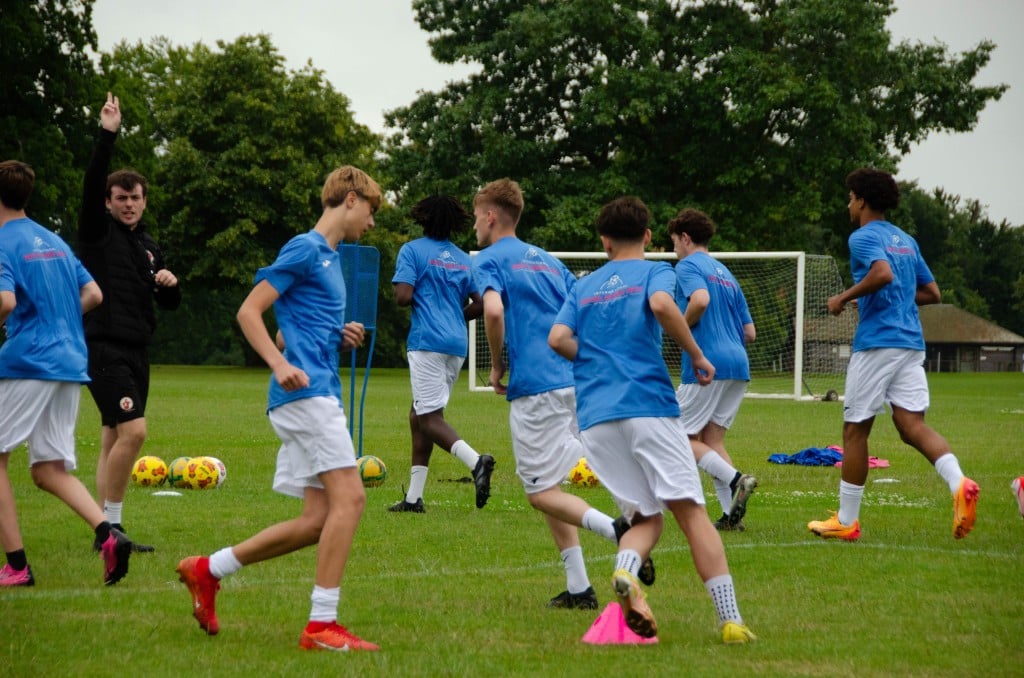
At Ertheo’s Spanish sessions, that works out as five and a half hours on the pitch a day, with scouts at the morning sessions and at the afternoon matches, every day. The England session is built differently — three days of double training sessions and one match day — because the criteria there are British: intensity, tempo and direct play, which show up quickly or not at all.
What happens if he stands out? Ask them to describe it
This is the question that exposes a weak product fastest, because a trial with no next step is a tournament with a good name.
Ours has three rungs and we describe them the same way every time:
- The trial. The family pays for their son to be seen by the scouts and the clubs taking part. That is what is bought: the access, not the result.
- The week at the club. The standout players earn a free trial week at the training ground of the club that selects them, with the squad and in front of its coaching staff. It cannot be bought or booked — it is won by standing out.
- The contract. If he stands out there too, a professional contract becomes possible.
Read what that does not say, as well. “The standout players” is not “your son”, and nobody guarantees the second rung. What is guaranteed is the thing you can check in advance: every participant gets an individual written report from the coaching staff — technique, physical condition, reading of the game, attitude and a recommended path. Whatever else happens, that comes home.
Why you cannot simply email a club and ask for a trial
Plenty of families try, and it is a reasonable thing to try. It rarely works, and the reason is structural rather than snobbish.
Recruitment is a shortlist exercise, not an open competition. A club is looking for a particular profile in a particular position and birth year, and its scouts are sent to watch the players already on that list. A club that opened its door to every email would spend its recruitment budget reading them.
That is the whole reason organised trials exist, and it is also the honest justification for their cost: you cannot ring up a professional club and arrange to be scouted. Somebody has to bring the scouts to a pitch, and that is the service being sold.
What Ertheo runs this winter, with the clubs named
So that this article is not just advice about other people’s products: sixteen professional clubs from Spain, Andorra, Portugal and England collaborate across three venues this winter — Barcelona (17-21 December 2026), Madrid (13-19 December 2026) and Northampton (15-19 January 2027). Dates, venues and booking are on the football tryouts page, and what a session is like hour by hour is in our guide to what a trial at a professional club is really like.
In England, Ertheo works with a scouting agency of more than a hundred professionals across the United Kingdom, and the clubs listed are a selection of those they represent, from different divisions. The session is held at the University of Northampton, and players get access to its high-performance laboratory for an individual physical assessment.
The age spans are a guide and never a sieve: the Spanish sessions are open from 12 and the England one from 16, both up to 23, for players at intermediate, advanced or elite level. A player close to the edge of that is a conversation, not a rejection.
Separately from the winter sessions, and for a problem that is not a footballing one: Ertheo also runs trials in Tangier, in the summer, for players who have the level but for whom a Schengen visa is the real barrier. Moving the trial to Morocco removes it outright.
Five checks before you book any open trial
These work on any operator, including us. If one of them has no concrete answer, you have learned something for free.
- Which clubs are sending someone, and under what condition? You want names, and you want the fixture-list caveat. Names with no caveat, or a caveat with no names, are both incomplete answers.
- How many sessions is he watched across? One session is an audition; several days is an assessment. The price often does not reflect which one you are buying.
- Is there an individual written report, and what does it cover? A specific answer — technique, physical condition, reading of the game, attitude — is a commitment. A promise of “feedback” is not.
- What is the next step for a player who stands out — and who decides it? If the answer is vague, assume there is no next step and judge the trial on the days themselves.
- What level is the rest of the group? A player well above or well below the others wastes the trip, and a good organiser will tell you honestly if it is the wrong room.
If the honest answer is “not yet”
Worth saying even though it costs us bookings. If a player is still building his technical foundation, a trial is the wrong purchase. At a trial he is measured exactly as he arrives; it is not where a player improves. An assessment that comes too early discourages far more than it teaches, and a fifteen-year-old who is told he is not ready by a stranger rarely hears the “yet”.
For that player a high-performance camp does more in a week than a trial does in a month. And if the real question is next year rather than next month, it is a different question altogether — we answer it in the guide to football school or academy.
In short
Open football trials are not one product, and the word “open” hides the difference. A club’s own recruitment day is cheap or free and worth trying if there is one near you. A third-party trial costs money and is worth exactly what it can tell you in advance about who will be watching and for how long. A selective trial with named clubs costs more and should be able to answer every question on the list above without hesitating.
What none of them can sell is the outcome. What the good ones sell is hours in front of people who assess players for a living, and a written record of what they saw. If you want to see how that looks when it is done properly, this winter’s sessions and the clubs collaborating with each one are on the football tryouts in Europe page.