
Soccer training routines have advanced greatly with the advent of technology and more comprehensive player analysis, both in training and professional phases.
As a result, certain exercises have become a standard part of every training session. These allow players to develop their technical skills and gain the confidence they need to demonstrate their abilities in matches every weekend.
However, some training sessions work better with beginner players and others with more experienced players. You need to take this into account when putting together your own exercise routine or drills.
If you need help with this, you can rely on our Coach Hub, which offers smart strategies and highly effective exercises for training your players. It also gives you tools to create your starting lineup, tactics, and more resources for coaches.
With that said, let’s get started with that list of exercises!
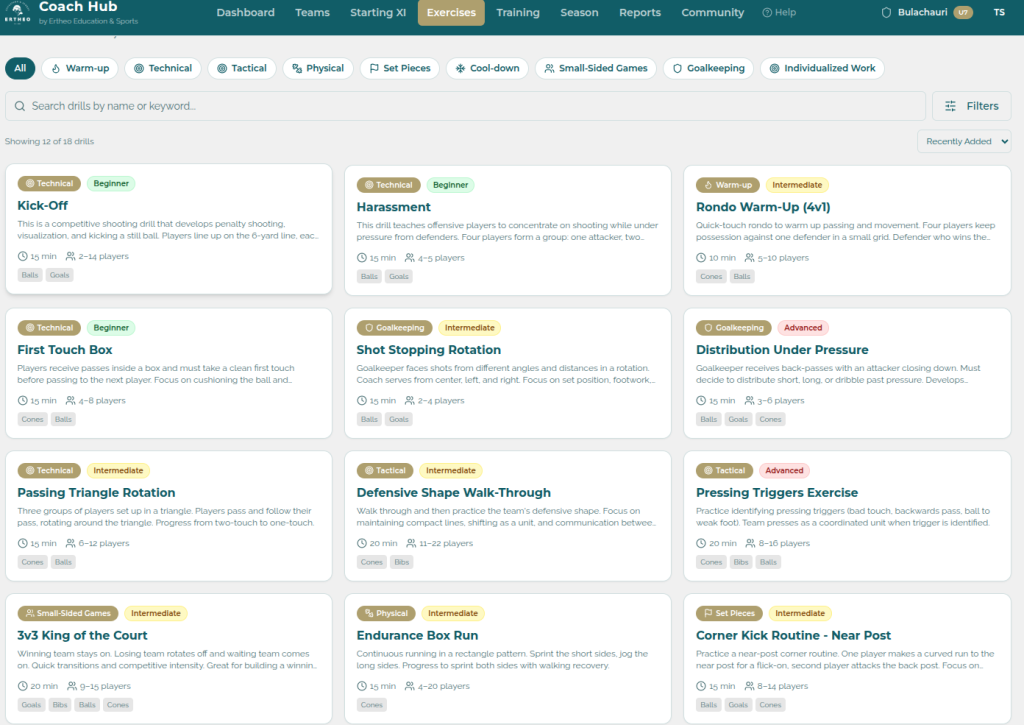
Table of Contents
Kick-Off, ideal for shooting.
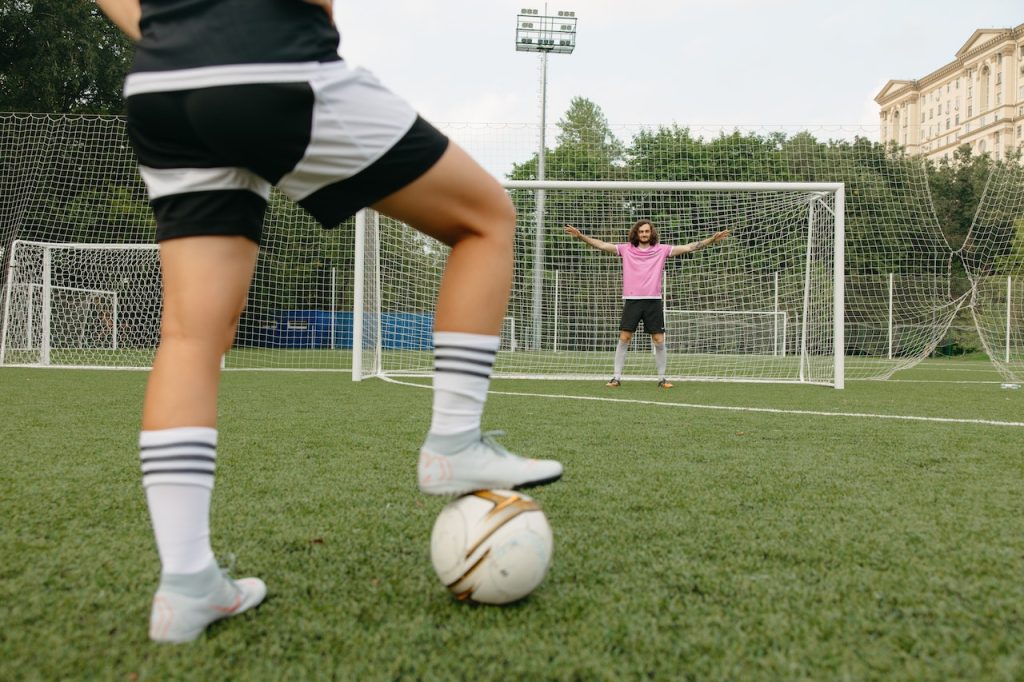
This competitive exercise focuses on improving players’ shooting ability, with an emphasis on shots from the penalty spot.
Players must line up behind the penalty spot and kick the ball towards the goal to score their own penalty. Players who fail to score a goal will be eliminated from the round.
For each round, players will have to move the ball about 4-5 meters further away from the goal to make the shot more difficult and require greater accuracy and power.
However, in order for the exercise to run smoothly, there must be a certain amount of space between the players so that each one can develop their shooting technique without being interrupted or distracted.
Benefits of this exercise.
- Exercise for beginner players.
- Develops good penalty-taking technique.
- Improves players’ concentration and focus.
- It is a simple exercise that adds dynamism and good vibes to the sessions.
- Gives players confidence to shoot at goal when the circumstances of the game demand it.
The classic rondo for passing and protecting the ball.
As well-known as it is effective, the classic rondo exercise remains one of the most effective ways to help players improve the accuracy and speed of their short passes.
In this exercise, four players must each stand at one end and start passing the ball between themselves, while another player tries to intercept the ball as quickly as possible.
The idea is for all players to pass the ball on the first touch, using both feet. In turn, the player acting as defender must play with high intensity to demand even more accuracy from their teammates.
Benefits of the classic rondo.
- Exercise for players of average skill
- Improves the accuracy of short passes.
- Encourages competitiveness among players.
- Encourages players to perfect their first-touch passing.
- Forces players to pass the ball with both feet.
Defensive line formation.
This exercise aims to help defenders synchronize their movements and form a solid line that can support the team in defensive transitions.
It is performed by first having the players position themselves at different heights and at a considerable distance from each other.
When given a signal, the defenders must run and line up perfectly to build the defensive phase.
The benefits of this defensive line exercise.
- Exercise for players of average skill.
- Improves the team’s defensive organization.
- Reinforces active communication between all members of the defense.
- Creates automatic responses that are essential for maintaining tactical order during games.
Endurance march in the area.
This exercise focuses entirely on the players’ endurance and physical conditioning, using the dimensions of the area as a parameter for intensity.
The drill begins with players sprinting on the ‘short’ sides of the area and jogging at medium speed on the longer sides.
As the minutes pass, players will have to sprint on both sides of the area, improving their aerobic endurance and recovery after each sprint. You can also alternate between sprints and recovery walks until the exercise is finally completed.
The benefits of this march around the perimeter of the area.
- Exercise for intermediate players.
- Builds ideal aerobic endurance for high performance.
- Strengthens physical condition to maintain a good pace, even when the player is exhausted.
- Corner kick routine to the near post.
Set pieces are an excellent resource for winning games and should be trained as a priority during the week.
This routine consists of having players make runs and break away toward the near post, while another player also attacks the far post as an alternative.
The purpose of this exercise is to help kickers achieve greater accuracy in each execution, as well as to automate the movements of players within the area.
However, the distance and location of the kick should be varied to make the exercise more dynamic and provide more options for the same play in matches.
Benefits of the near-post corner routine.
- Exercise for intermediate players.
- Allows players to practice and perfect their heading skills.
- Increases the accuracy of the corner kick taker(s).
- Increases the chances of scoring from set pieces in matches.
Passes under pressure for goalkeepers.
This exercise challenges goalkeepers to make good decisions while they have the ball at their feet.
Forwards must press the goalkeeper at different heights, while other teammates break away and offer themselves as passing options.
The intention is for the goalkeeper to develop the criteria to assess the risks of each pass, while the forwards practice their pressing and defensive play.
- Exercise for intermediate-advanced players.
- Improves goalkeepers’ decision-making with the ball at their feet.
- It sharpens the team’s pressing and defensive play.
- Improves the team’s overall positioning in terms of pressure.
Identification of pressure triggers.
Another ideal exercise for reinforcing the team’s collective pressure. This drill consists of helping players recognize the opponent’s mistake in order to initiate intense pressure and win the ball.
The players should be divided into two groups, one with the ball trying to retain possession as much as possible with accurate passes and short runs.
The other group must be alert to any mistakes made by an opponent, whether it be poor ball control, a pass that falls short, or a misdirected pass.
Benefits of this trigger identifier.
- It increases the team’s collective and tactical awareness.
- Creates automatic pressure ideal for outpacing the opposing team.
- It trains the collective sense of pace, pressure, and physicality.
With these exercises, your team will train basic fundamentals, intermediate technical exercises, and advanced mechanics to improve collective and individual performance.
And if you’re looking for even more possibilities, remember that you have the Coach Hub to expand your resources as a coach.