
Getting started in any sport is tough—we make a lot of mistakes, we struggle to get into the flow of the game, and other things happen that drive us crazy. But when it comes to tennis, all these challenges might be a little more intense. The reason is pretty clear: to learn how to handle a tennis racket, you have to be patient. So we need to think carefully and know how to choose a tennis racket—not just any will do. There are several factors that influence choosing the right one, more than you might think.
To help you decide which racket to buy, we’re going to give you a little guidance by explaining the factors to consider so you don’t regret your choice as you take your first steps in tennis.
Types of Tennis Rackets
The first step is to know what types of tennis rackets are available on the market and which ones will help us improve during our first lessons. Racket manufacturers typically refer to three main types:
Improvement and Power Rackets
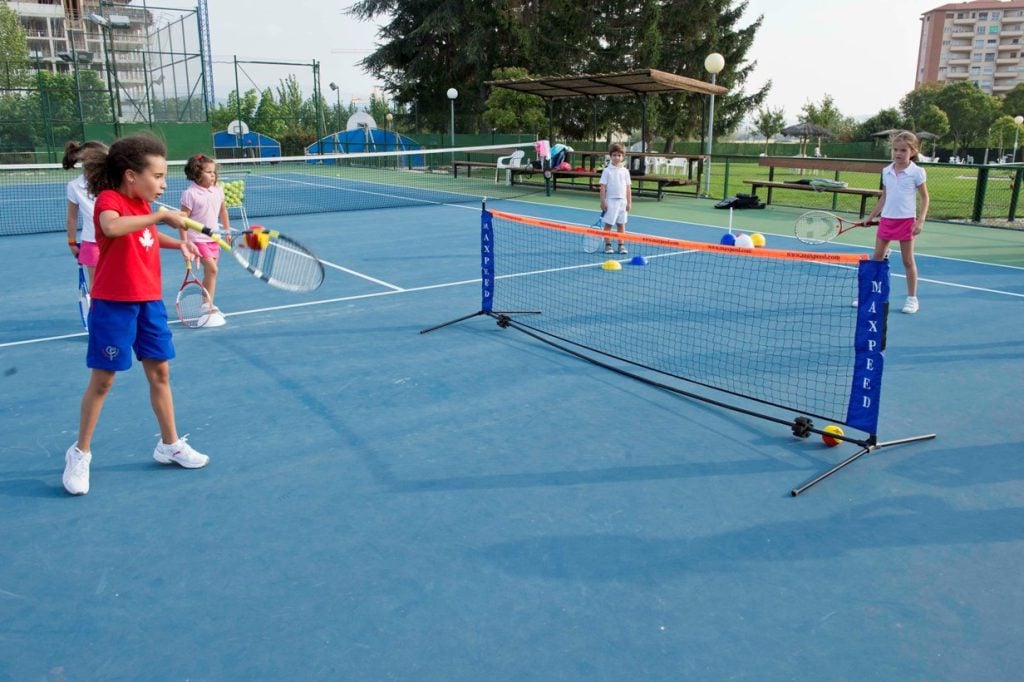
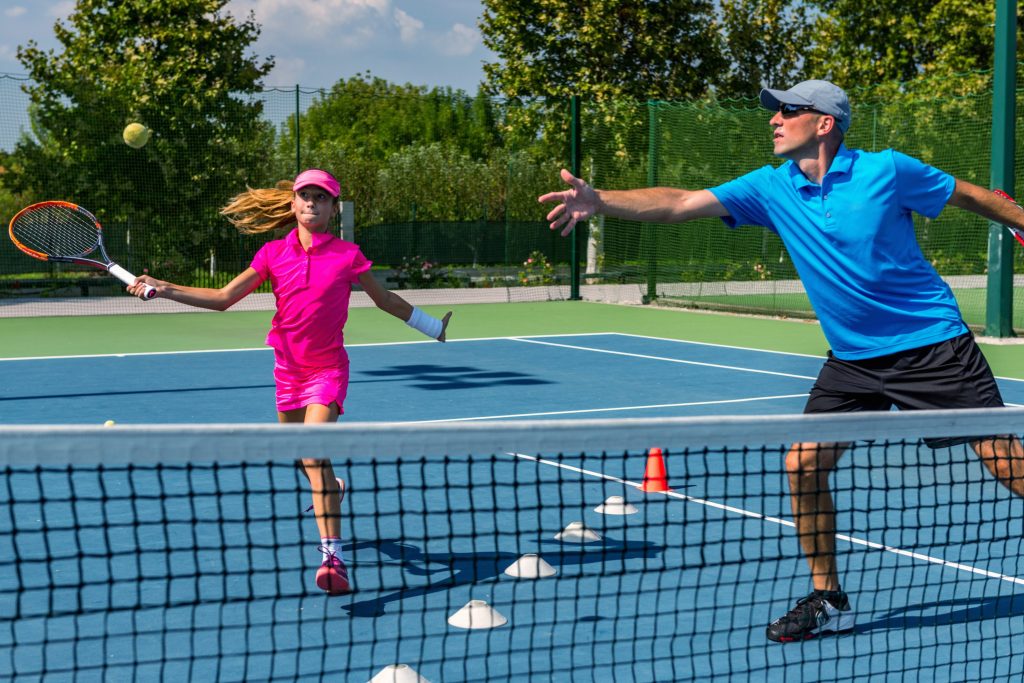
To start controlling the ball without getting frustrated, there are beginner rackets designed with oversize or super-oversize heads. This means the hitting surface—where the strings are—is larger than normal, around 700–900 square centimeters. These are perfect for tennis drills for children just starting out in the sport, where the priority is getting familiar with the racket rather than perfecting strokes.
This type of tennis racket is stiff, long, and has a neutral or slightly head-heavy balance, which helps distribute more weight toward the hitting area.
As an extra detail, we’d like to mention that they’re designed for players with a short, slow swing who are looking for more power, though we’ll explain the different types of swings a bit further down.
Intermediate and Advanced Rackets
They combine various features for players who have been playing for some time but need to continue improving their shots. Intermediate rackets are lightweight, with varied balance, a midplus head (613–658 cm²), and a length slightly longer than standard models. As for hitting power, it never gets very high, ranging from low-medium to medium-high, so they’re usually used by players who want more control and maneuverability.
Control rackets
This is where the tennis rackets bought by the most experienced players come into play—those who have been hitting the ball back and forth for many years, coaches, semi-pros, and ATP Tour players, the celebrities we see every week at the major tournaments.
Control models are heavier, have a smaller head, and the frame profile is usually thinner and more flexible. Additionally, the head-light balance allows the player to have greater control and precision on shots. Every professional seeks to customize their racket; for example, Rafa Nadal added more weight to his in early 2017. It seems to have worked well for him…
Key features to consider when choosing a tennis racket
Weight
Weight is one of the most important factors to consider when choosing a tennis racket. Heavier rackets require more strength to swing, generate more power on impact, and transmit fewer vibrations. But alongside these pros, they also have a significant con: they are less maneuverable. A tip to make the most of these advantages is to lengthen your swing and maintain good speed.
In terms of weight, we can divide them into two types: we can choose a heavy racket with a light head, or conversely, a lighter racket but with more weight in the head.
The former are considered control rackets, with which professionals impart their own power to the ball. The latter have a lighter handle and more weight in the part where the ball is struck, so the playerwill have better control over shots without losing much power.
Balance
Balance is closely related to weight and its distribution within the racket. Balance determines the“stability”of the racket and, consequently, the control available with each shot. For example, when the racket is “head-heavy”—that is, it has more weight in the hitting zone than in the handle—the power is much greater, but so is the lack of precision. The ideal would be to find a balance where we have equal parts power and control, without one outweighing the other.
Stringing Area (Head Size)
In tennis, we refer to the hitting surface—where the strings are located, which we’ll discuss later—as the head size. If the head is large, the control we have over the shot will be less, but the power will be greater. Conversely, a racket with a small head will provide more precision; the downside is that we’ll need to apply more force to the shot to achieve good speed.
As an additional note, tennis rackets with small heads are generally used by more experienced players seeking ball control, while those with large heads are intended for intermediate players who need more power.
Length
In professional and semi-professional tennis, regulations stipulate that the racket’s length must be between 68.58 cm and 77.66 cm. A longer racket will help us reach the ball better on baseline shots and generate more power; however, it is harder to handle and offers less control over the shot.
This is because the weight is farther from the hand, which affects our ability to volley and return shots that are closer to the net. As for grips, rackets are becoming increasingly lighter thanks to innovations in materials, so the world’s leading tennis manufacturers are constantly striving to avoid excessively increasing the weight of rackets.
Currently—and this is constantly changing—the racket handle is incorporating a dampening system for vibrations and impact, which benefits players’ performance.
Some players are forced to use a longer racket despite having less control, such as David Ferrer, who, due to his short stature (5’9”), uses a racket that is longer than those typically used by other ranked players—about 70.8 cm.
Stiffness
Stiffness is a factor that greatly affects the player’s feel and the vibration when striking the ball. Rackets characterized by flexibility tend to provide less power, as they tend to flex backward upon impact. Despite this, flexibility also helps the player experience fewer vibrations during the swing.
Stiff tennis rackets, in addition to power, provide directional control. However, stiffness is a factor that increases the vibrations the racket transmits to the player’s arm. Very flexible tennis rackets are less powerful because the frame tends to flex backward at the moment of impact, but they absorb vibrations better.
Less is said about another consequence of frame stiffness, which is the amount of spin the racket can generate. Stiffer rackets don’t produce as much spin as flexible ones, and the reason is simple: because they are stiffer, the ball is repelled from the strings more quickly.
Pattern
This is where the racket’s stringing comes into play, and many players spend a lot of time finding the setup that best suits their game. When choosing a tennis racket for the first time, you might not give this much thought, but as you improve and play regularly, you’ll realize how to find the setup that benefits you the most.
The racket head is the hitting surface, where the strings are woven together; depending on how they’re strung, this will affect our shots in one way or another.
The number of strings and the distance between them play a role here; essentially, the string pattern can be more open or more closed.
We’re going to explain the differences so you can decide for yourselves how to set up your tennis racket.
First, let’s discuss the open string pattern, where the ball deflects more than with a closed pattern. This type of stringing isn’t as tight, so the ball sinks deeper between the strings and leaves the racket with more power. One downside is greater string wear and a higher risk of breakage, since the strings have more freedom to move.
With a closed string pattern, the opposite is true: the ball is repelled with less power, but we have more control over the shot. We’ll get less spin, though with a closed string pattern, we won’t have many breakages. As we might deduce, this string pattern is better suited for players seeking more control, while those who base their game more on power will use tennis rackets with a more open string pattern.
Racket Ranges
The leading racket brands release different ranges of similar models that differ mainly in the material they’re made of. Naturally, the retail price varies greatly depending on the racket’s range. Here are the three main ones:
- Low-end rackets are primarily made of aluminum and typically cost between 30 and 50 euros. These types of rackets are suitable for very occasional players who view tennis as a form of entertainment.
- Mid-range rackets are of higher quality and cost between 60 and 120 euros. They are made of graphite and fiberglass and are the most commonly used by players who are learning to play tennis.
- High-end rackets range in price from 120 to 400 euros and are made from a blend of highly durable materials such as graphite, titanium, or carbon. Many players opt for this type of racket—whether they are professionals, semi-professionals, or beginners—as these rackets allow for a powerful shot and maximum control during the swing.
One of the most renowned brands, Babolat, ushered in a new era in tennis by incorporating revolutionary new technologies to assist professionals. The brand supplies rackets to Rafa Nadal, and in this video, it presents its model designed to analyze every aspect of a tennis player’s game.
Types of Swings
After learning about the most important factors to consider and reviewing the ranges available on the market and their prices, the final and most important step in choosing a tennis racket is to determine the player’s swing type. The swing is the characteristic motion each tennis player makes with their arm when hitting the ball, and it greatly influences which racket they should buy. The swing can be:
- Short and slow swing: typical of beginners or very experienced players. For players with a short and slow swing, rackets are very lightweight, with a wide head size, a high balance (weight toward the head), and an open string pattern. These features provide great power with little effort and maximum comfort. These are typically high-end, high-quality rackets.
- Medium swing: typical of intermediate-level players. For players with a medium swing, rackets also have medium specifications, with medium weight, head size, and balance. These are the most widely used because they suit a wide range of players, whether beginners, intermediates, or competitive players. This type of racket is typically found across all price ranges, from the lowest to the highest.
- Long Swing: used by highly experienced professional players. Rackets designed for players with a long, fast swing are significantly heavier, with a smaller head size and a low balance (weight toward the handle). Control over the shot is much greater, as is precision. These rackets are typically designed for both the mid-range and high-end markets.
Although some may be born with talent, a diamond must be polished, and we need to know when the right time is to start playing tennis—we shouldn’t rush into it. So, in this blog post, you’ll find some information to help you determine when children can start playing tennis.
With all these tips, you’re ready to take the plunge and choose the racket that best suits your game or your current stage of learning, but remember: a racket isn’t magic, and it takes a lot of work to master it. So keep at it, and most importantly, enjoy playing tennis.